
Commercial Validation Canvas
A simple, numbers-first method to prove customer value, willingness to pay, and a light business case for healthcare and life sciences.
Leonard Rinser · Nov 08, 2025
INTRODUCTION
Early-stage deep tech startups often excel at innovation but struggle with commercial validation, proving that a real market needs their technology and will pay for it. This gap is a huge problem: lack of market need is the single biggest reason startups fail (accounting for about 42% of failures). Deep tech ventures, especially in fields like healthcare and life sciences, must ensure the science and the market align. Startups run on two clocks oftentimes, the technology clock and the market clock, and validation is about synchronizing them. In practice, this means you need to prove and show not only that the tech works, but also that someone will pay for it with a clear path.
Yet, surprisingly few companies take the time to financially quantify their value for customers. Some studies show that only 5% of companies have financially quantified value propositions, so doing this will instantly differentiate you and give you an edge with customers and investors. After all, if a solution doesn't deliver tangible value over the status quo, it has no reason to exist . The goal of the framework below is to provide deep tech founders and tech transfer teams a clear method to validate the commercial viability of their innovation. We will guide you through a step-by-step process with our to a "Commercial Validation Framework" to identify your market, quantify your value proposition in financial terms, and gather evidence that your target customers are both interested and willing to pay. This framework is especially tuned for B2B deep tech in industries like healthcare and life science, where proving economic value early can accelerate adoption. But it also works for B2C and general companies, we only focus on healthcare and life science.
THE CANVAS
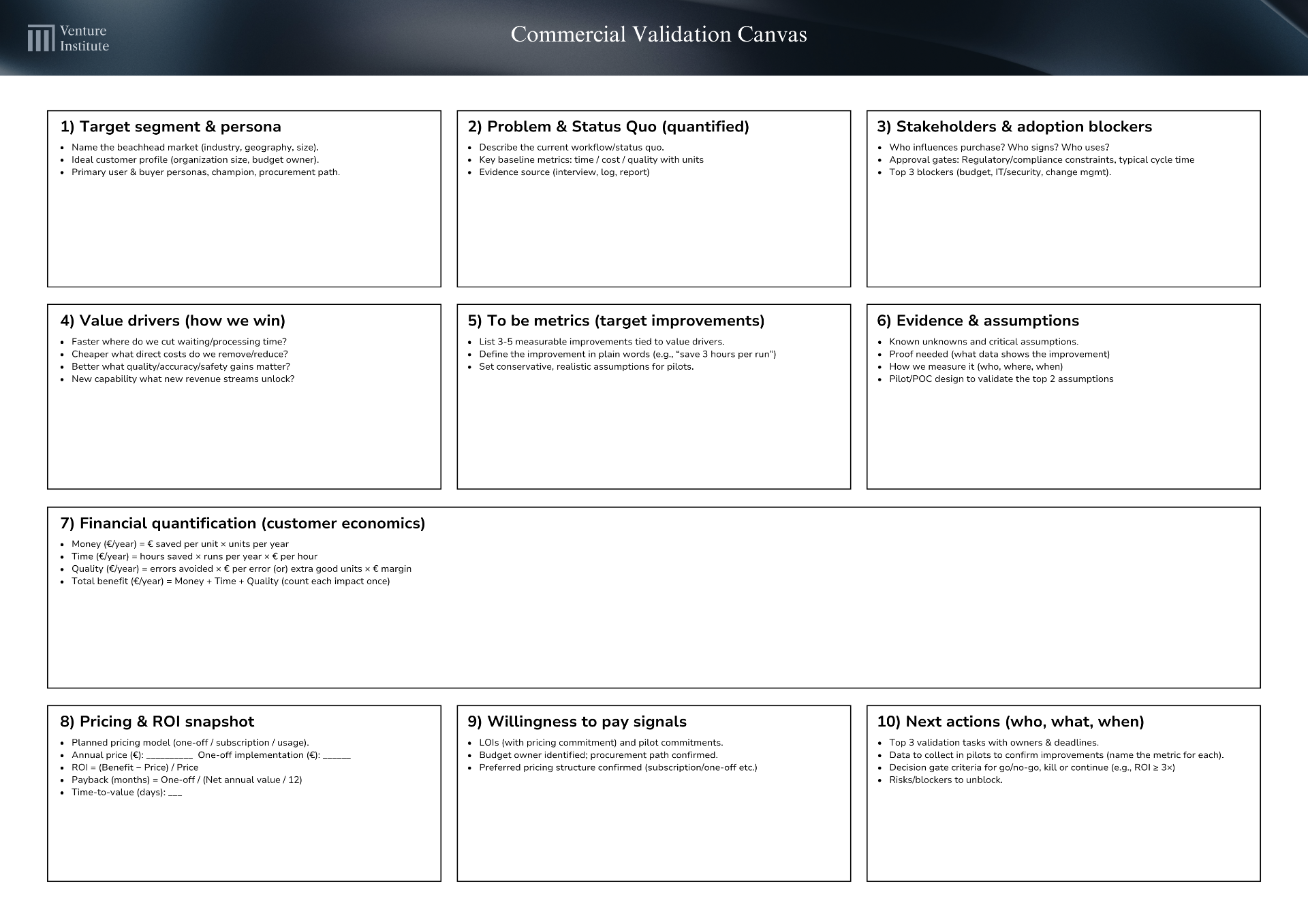
The Commercial Validation Canvas.
01
Target segment & persona
- Name the beachhead market (industry, geography, size).
- Ideal customer profile (organization size, budget owner).
- Primary user & buyer personas, champion, procurement path.
02
Problem & Status Quo (quantified)
- Describe the current workflow/status quo.
- Key baseline metrics: time / cost / quality with units
- Evidence source (interview, log, report)
03
Stakeholders & adoption blockers
- Who influences purchase? Who signs? Who uses?
- Approval gates: Regulatory/compliance constraints, typical cycle time
- Top 3 blockers (budget, IT/security, change mgmt).
04
Value drivers (how we win)
- Faster where do we cut waiting/processing time?
- Cheaper what direct costs do we remove/reduce?
- Better what quality/accuracy/safety gains matter?
- New capability what new revenue streams unlock?
05
To be metrics (target improvements)
- List 3-5 measurable improvements tied to value drivers.
- Define the improvement in plain words (e.g., "save 3 hours per run")
- Set conservative, realistic assumptions for pilots.
06
Evidence & assumptions
- Known unknowns and critical assumptions.
- Proof needed (what data shows the improvement)
- How we measure it (who, where, when)
- Pilot/POC design to validate the top 2 assumptions
07
Financial quantification (customer economics)
- Money (€/year) = € saved per unit × units per year
- Time (€/year) = hours saved × runs per year × € per hour
- Quality (€/year) = errors avoided × € per error (or) extra good units × € margin
- Total benefit (€/year) = Money + Time + Quality (count each impact once)
08
Pricing & ROI snapshot
- Planned pricing model (one-off / subscription / usage).
- Annual price (€): __________ One-off implementation (€): ______
- ROI = (Benefit − Price) / Price
- Payback (months) = One-off / (Net annual value / 12)
- Time-to-value (days): ___
09
Willingness to pay signals
- LOIs (with pricing commitment) and pilot commitments.
- Budget owner identified; procurement path confirmed.
- Preferred pricing structure confirmed (subscription/one-off etc.)
10
Next actions (who, what, when)
- Top 3 validation tasks with owners & deadlines.
- Data to collect in pilots to confirm improvements (name the metric for each).
- Decision gate criteria for go/no-go, kill or continue (e.g., ROI ≥ 3×)
- Risks/blockers to unblock.
01
STEP ONE
Define Your Target Market and Customer Segment.
Begin by clearly defining who your potential customers are and which market segment you will focus on first. Deep tech innovations often have many possible applications, the Application Field Matrix can help map out different fields. Now, pick a specific beachhead market, a well-defined industry sector or customer group that has the most urgent problem your technology can solve. It's crucial to understand the environment and context of this market before developing your offering. Start with a thorough market analysis and value chain analysis to map out how the industry works . Identify the current solutions or approaches your target customers use (including any competing products or workarounds) and the key players providing those solutions. This competitive and ecosystem insight will help you pinpoint where your product can stand out.
Engage in early expert and customer interviews to quickly learn the market's dynamics and pain points. Speaking with industry experts, potential users, or buyers helps reduce uncertainty by revealing how things are done today and where the biggest inefficiencies or gaps are. At this stage, also perform a target group analysis: clarify the characteristics of your ideal customer (e.g. hospital labs of a certain size, or biotech manufacturing companies in a certain region) . Estimate how many such potential customers exist to gauge your Total Addressable Market (TAM). Even a rough market sizing is valuable to ensure the opportunity is big enough. For example, if your technology is for biomanufacturing quality control, count how many biomanufacturing facilities or companies could need it and how much they might spend annually, this gives a first sanity check on market potential. Don't skip this step: you need confidence that a substantial market of reachable customers exists. In summary, choose a focused segment, understand its ecosystem, and quantify its scale. This will be the foundation for all subsequent validation steps.
02
STEP TWO
Understand the Customer's Current Situation and Pain Points.
With your target segment defined, dive into understanding your customer's current situation. Your goal here is to map how the target users are currently solving (or working around) the problem your technology addresses, and to identify pain points in that process. Start by pinpointing the primary pain your innovation is meant to solve. Review the pain points you've heard from potential customers or observed in the field. For deep tech in life sciences, a pain point could be something like "it takes 8 hours to run this lab assay" or "manufacturing downtime due to quality checks costs $50k per incident." Identify which pain is most critical to the customer, for instance, is it excessive time, high cost, low accuracy, risk compliance issues, etc.? Focus on the pain that truly matters to them, if customers say their biggest headache is the manual effort and time a task takes, then speed is the key metric to look at .
Next, map the current process (the "as-is" scenario) in detail, especially with respect to that key metric. Document the steps the customer takes and how long each step takes, or how much each step costs, depending on the pain metric. Essentially, you are establishing the baseline performance of the status quo. For example, if your product aims to reduce lab testing time, how is the test done today and how many hours does each phase take? If your innovation reduces costs, figure out the current cost structure (materials, labor, downtime costs, etc.). Wherever possible, attach numbers to these pains: e.g. "currently it takes 3 days to analyze a sample" or "the defect rate is 5%, causing $200k scrap per quarter." These numbers may come from customer interviews, industry research, or pilot studies. If you don't have exact figures, use estimates from your conversations or published data. The point is to quantify the pain in terms that matter to the customer (time, money, quality, etc.). By the end of this step, you should have a clear picture of the customer's "as-is" scenario with metrics, essentially the problem quantified. This will serve as the reference point to later measure how much better the "to-be" scenario with your solution could be.
03
STEP THREE
Identify the Value Drivers Your Solution Offers.
Now, articulate how your solution changes the game for the customer. This means identifying the specific value drivers, the improvements or benefits, that your technology can deliver relative to the current scenario. Think of this as mapping a "to-be" scenario: how will the key metric(s) change if the customer uses your product? In deep tech, value can come in various forms, but most fall into a few broad categories: doing something faster, cheaper, or at higher quality than before. (There can also be entirely new capabilities your tech enables, but those typically still translate to saving time, reducing cost, or improving outcomes in some way.) Determine which category (or categories) your primary value lies in. For example, does your medical device automate a process and thus save labor time? Does your AI software increase accuracy of a diagnosis, reducing costly errors? Does your new material extend the life of a product, lowering maintenance costs? List out these value hypotheses clearly.
For each value driver, define it in measurable terms. It can be helpful to frame them as hypotheses initially, e.g. "Using our solution, the lab technician can complete the assay in 1 hour instead of 8" or "Our algorithm will catch 90% of defects early, halving the scrap rate." Be as specific as possible with the improvement claimed (percentages, absolute reductions, etc.). Avoid vague promises like "better" or "more efficient" without quantification. A deep tech value proposition should ideally be backed by hard numbers, even if provisional. In fact, there are only a few ways monetary value is created for customers: adding revenue, reducing cost, or avoiding future cost . Explicitly tie your solution to one or more of those. For instance, "faster assay turnaround" translates to avoiding cost (labor hours saved) and potentially adding revenue (more tests can be run). Improving accuracy translates to avoiding cost (fewer mistakes) and possibly adding value to the customer's product quality (which could allow higher pricing). As you list each value driver, also note how the solution achieves it (the feature or mechanism) to ensure it's credible. This exercise defines the "to-be" scenario in principle, in the next step, we will attach real numbers to it.
04
STEP FOUR
Quantify the Improvement: Calculate the Financial Value.
This is the core of commercial validation: quantifying the value proposition in financial terms. Here you will calculate the difference between the customer's current state (from Step 2) and the improved state with your solution (from Step 3). Essentially, Value Proposition = Value in the "to-be" scenario, Value in the "as-is" scenario. Go through each value driver and put numbers on the improvement. For example, if the current process takes 8 hours of labor and your solution takes 1 hour, that's a 7-hour savings. Multiply that by the labor cost per hour (say $50/hour) to get $350 saved per occurrence. If that process happens 100 times a year, that's $35,000 saved per year for the customer. Do this for each area of impact: time saved, errors reduced, output increased, etc., converting them into monetary terms. Some improvements directly save costs (e.g. reduced labor, less waste), while others increase revenue (e.g. faster turnaround means the customer can handle more volume or charge a premium for faster service). Be thorough but realistic, use conservative estimates unless you have strong data, to maintain credibility.
If your value drivers include less tangible benefits (e.g. improved quality or compliance), find a proxy to monetize them. For instance, higher product quality might reduce warranty claims or allow a price premium, compliance might avoid regulatory fines or unlock market access. It's not always easy to quantify things like "improved patient outcomes" in healthcare, but try to link them to an economic metric (perhaps reduced hospital readmission costs, etc.). Remember, there are typically three broad buckets of measurable benefit: higher quality, greater speed, or lower cost , and all can ultimately be expressed in terms of dollars saved or gained.
Once you've crunched the numbers, aggregate the total value your solution delivers to a typical customer in your target segment. For example, you might conclude that "Using our device, a lab saves approximately $50,000 per year in labor and materials, and gains the capacity to run 20% more tests, representing an additional $100,000 in revenue. Total benefit ≈ $150,000/year." Now critically compare this to what you plan to charge (or a reasonable price for your solution). If your product would cost, say, $30,000 per year, providing $150,000 of value, the ROI (Return on Investment) for the customer is very attractive. On the other hand, if your solution costs more than the quantified benefit, you either need to adjust your pricing or strengthen the value proposition. The aim is to ensure the customer clearly sees, "If I pay X, I get back 5X (or more) in value." In many B2B scenarios (like SaaS or industrial solutions), offering a 5:1 or 10:1 ROI is a good practice to overcome inertia and budget hesitancy.
Finally, formulate a concise quantified value proposition statement that you can use in pitches and discussions. This is a one-sentence summary of your economic value. For example: "Our solution reduces the production line's downtime by 40%, saving $200K annually in maintenance and lost output" or "By automating data analysis, we cut reporting time by 80%, which for a lab equals about $50K in labor cost savings per year". Crafting such a sentence forces you to be crystal clear about the benefit and its magnitude. As guidance, you should be able to say "We reduce Key Metric by X%, resulting in Y dollars saved/gained" . When you present this to customers or investors, it directly clarifies the value your solution adds. Moreover, going through this quantification process will differentiate you: most companies don't do it, and those that do can close more deals and even command premium pricing because they proved the financial impact for the customer. At this point, you have a first-pass business case for one customer, a cornerstone of commercial validation.
05
STEP FIVE
Validate Willingness to Pay and Market Interest.
With a solid quantified value proposition in hand, the next step is to verify that customers agree with it and are willing to pay for your solution. Paper calculations are great, but nothing beats feedback from real potential buyers. Return to your target customers (or new ones in the segment) and engage them with your findings. This can be done through follow-up interviews, pitch presentations, or even small pilot projects. Share the problem understanding and your proposed solution's impact: for example, "We've calculated we can save a lab like yours around $150K a year. Does that figure resonate? Does this solve a pain you'd invest in?" carefully consider their reactions. If they respond with enthusiasm, "That would be amazing, I'd sign up if you can prove it" that's a strong positive signal. If they are skeptical about the numbers, ask which assumptions they feel are off and gather more data to refine your model. In some cases, you might discover an important benefit you hadn't considered, or conversely, learn that some of your assumed savings aren't as valuable to them as you thought. Use these conversations to iterate on your value hypothesis.
Crucially, test the willingness to pay. It's one thing for a customer to love the idea of saving $150K, it's another for them to commit part of that savings to purchase your product. You should directly ask questions like, "If we can deliver $150K in savings, would you be comfortable paying $30K for the solution?" or whatever your pricing model is (license fee, subscription, per-use, etc.). You want to validate that your pricing is in an acceptable range given the value, essentially confirming the ROI is compelling from the customer's perspective. This might involve discussing different pricing structures (one-time purchase vs. recurring, or performance-based models) to see what resonates. Some startups at this stage conduct informal pricing experiments, for instance, presenting slightly different pricing packages to different prospective customers to gauge reactions, or A/B testing price points via landing pages. Early on, conversations might be more qualitative ("That price seems reasonable" or "Our budget could stretch to that for these benefits"). As you progress, you might try to get more concrete commitments.
A powerful outcome of this step is securing Letters of Intent (LOIs) or pilot program agreements from potential customers. An LOI is basically a non-binding letter saying, "If you build this solution to do X, we intend to purchase Y units at approximately Z price." This is gold for a deep tech startup, it's evidence that customers mean what they say. It also provides immense confidence to investors or stakeholders that there is real demand. Aim to get a few LOIs if you can, even one or two from credible industry players can validate your concept. As a best practice, treat these early customer engagements as part of your development process: you're co-creating the solution's business case with input from the market. By the end of this step, you should have external validation that (a) the problem is important, (b) your solution's value makes sense, and (c) customers indicate a willingness to pay a price that makes the economics work. In other words, you're gathering proof that there is a market for your deep tech innovation, not just a technology in search of a market. This will greatly reinforce the confidence of your team and any investors watching your progress.
06
STEP SIX
Build a Light Business Case (Market Potential and Strategy).
The final step is zooming back out to the broader business case and commercial strategy. At this point, you have data on individual customer value and pricing. Now you need to assess what it means for your venture at scale: Is this a financially attractive business to pursue, and what will it take to execute it? This involves a few components:
Market Potential: Revisit your market size estimates with the new information. Based on what you've learned, how many customers could you realistically sell to in your beachhead segment (and later in adjacent segments)? Calculate a serviceable obtainable market, for example, "we can likely capture 10% of the 500 companies in this niche over 5 years, which at $30K annual revenue each would be $1.5M annual revenue." Ensure this potential aligns with your growth ambitions and justifies the effort/investment. If it looks small, consider whether the market is too niche or if you need to expand to other segments sooner.
Revenue Model and Profitability: Using your tentative pricing and customer uptake rate, project your startup's revenues over the next few years. This doesn't need to be an intricate 20-sheet Excel model at this stage; a simple model will do. Also outline your cost structure at a high level, what will it cost to deliver this product? (For deep tech, consider costs like manufacturing, customer support, compliance/regulatory, etc.) The goal is to see if, on paper, the numbers can lead to a profitable business. For instance, if each sale is $30K and it costs you $5K to deliver, that's good unit economics. If it costs $50K to deliver, that's a problem. Factor in also the cost of customer acquisition if known (deep tech sales cycles can be long and expensive). At the end of this exercise, you should have an initial profitability outlook and an understanding of how many customers or sales you'd need to break even.
Scalability and Strategy: Consider any bottlenecks to scaling your business. Deep tech products in healthcare and life science often face regulatory hurdles, long sales cycles, or integration challenges. Make note of these in your business case narrative. Identify what resources or partnerships you might need to scale (e.g. a distributor for hospital systems, or a regulatory expert for FDA approval). Also, think about your go-to-market strategy in outline: will you do direct sales, work with channel partners, offer pilot programs first, etc.? This strategic thinking ensures that your validated concept can actually be executed in the real world.
Compile these elements into a simple business case document or slide deck. It should summarize the opportunity: X problem for Y market, our solution delivers Z value, we charge this amount, we project $___ in revenue by year __, with roughly ___% margins, and here's how we'll go to market. The idea is not to have a full-fledged business plan, but a solid evidence-based story that the business is viable. Many tech transfer professionals refer to this as checking commercial viability: you've shown technical feasibility elsewhere, now you're showing economic feasibility. This comprehensive look may also highlight remaining assumptions or risks, for example, maybe you are assuming you can achieve a certain cost of goods, or that regulatory approval will come in time. Make those assumptions explicit and consider how you might validate them as you move forward (they could be the next things to test). By refining your business model with the data gathered, you are essentially reducing uncertainty and making a case that proceeding with product development and market launch is a sound investment .
CONCLUSION
Conclusion: Iteration and Preparation for Launch.
Developing a deep tech product without validating its commercial potential is like building in a vacuum. By following this step-by-step framework, from identifying a target market and quantifying your value, to getting real customer validation and crafting a business case, you dramatically increase the odds of success. Importantly, this is not a one-and-done process. Treat it as an iterative loop: if new information arises (e.g. customer feedback suggests a different pain point is actually more important), cycle back through the steps. Adjust your target segment or value proposition and quantify again. Each iteration will sharpen your understanding and make your eventual go-to-market strategy more solid.
For founders and tech transfer professionals, using a structured Commercial Validation Framework or checklist can keep these efforts organized. You might even create a visual one-pager that captures each element: the customer segment, their current "as-is" metrics, your solution's "to-be" impact with numbers, the calculated ROI, pricing strategy, market size, and key validation evidence (like LOIs or pilot results). This can serve as a living document to guide team discussions and investor updates.
In the end, successful commercialization of deep tech in healthcare, life science, or any domain comes down to this simple equation: does the innovation provide significantly more value to customers than it costs? By methodically proving that equation with data, you not only convince cautious industry customers, but you also arm yourself with a compelling story for investors. You'll be able to say, "We have spoken to our customers, we understand their needs, and we can show that for every $1 they spend on our product, they get $5 (or more) in return." That is the kind of commercial validation that turns a promising technology into a fundable, scalable business. With this framework, deep tech founders can approach their market confidently, knowing they have evidence to back up their vision and a clear roadmap to reach product-market fit on the commercial side.
WORK WITH US
Let's build the future of health together.
Whether you're a founder, an investor, or a leader at a global company, we'd love to hear from you.